Blood-material contact initiates a rapid sequence of biological events. Following exposure to an artificial surface, plasma proteins adsorb to the material and form a conditioning layer that facilitates platelet adhesion and inflammatory signalling. These early interactions influence the later biological response and can contribute to thrombus formation and device failure. Consequently, engineering surfaces that maintain favourable biological interactions is an important aspect of the design of blood-contacting medical devices, from vascular catheters to guidewires.
Increasing Demands on Blood-Contacting Devices
Modern guidewires and other vascular access technologies are expected to maintain consistent performance under increasingly complex clinical conditions. As a result, even minor reductions in blood compatibility can have significant consequences, with surface-related complications contributing to flow disruption and reduced device efficiency over time. As time progresses, sustained blood contact will amplify the consequences of poor hemocompatibility. This materialises as thickening protein layers, accumulation of platelet-rich thrombi and extensive biofilm formation.
Device failure modes over sustained periods of time are cumulative rather than immediate making it difficult to detect such failures until performance has already degraded. Furthermore, because these effects originate at the surface, they are not fully addressed by anticoagulation or mechanical design alone. Systemic anticoagulation (e.g., heparin) blocks the coagulation cascade but does nothing to stop proteins from binding to the device surface and carries bleeding risk. Geometric changes aimed at reducing shear stress or flow stagnation (e.g., smoothing junctions, widening channels) can lower platelet activation but don’t alter the surface chemistry that drives adsorption.
How Hydrophilic Coatings Contribute
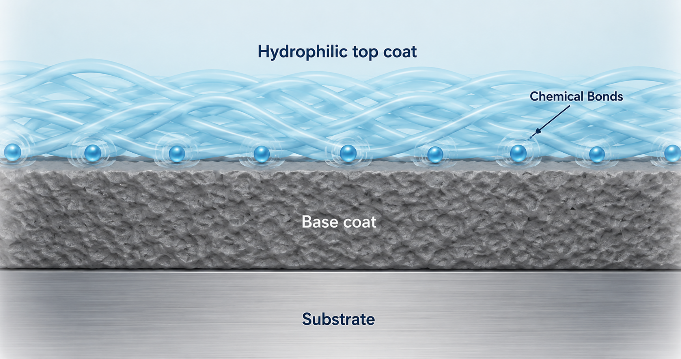
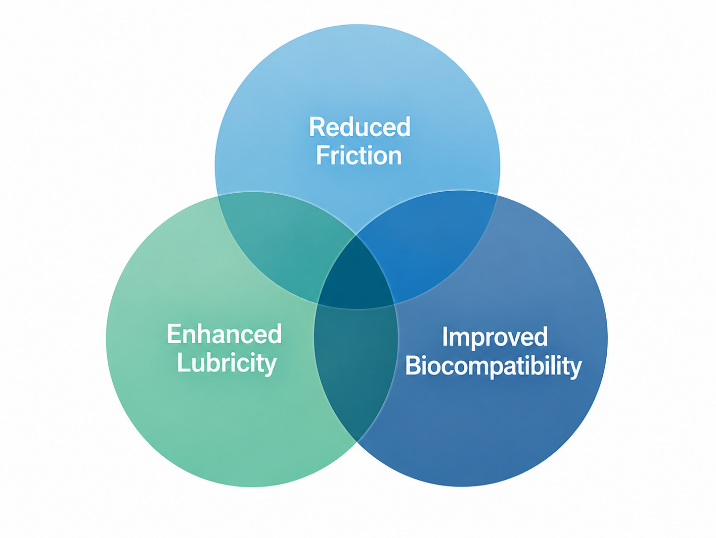
Hydrophilic coatings modify the device-blood interface by forming a densely hydrated surface layer. By maintaining a tightly bound water layer at the surface, they make it more difficult for proteins and cells to adhere. This reduces the formation of the biofilm that drives downstream thrombotic and inflammatory responses. Beyond antifouling performance, these coatings improve surface lubricity by reducing mechanical friction during insertion and within flow circuits. Such a reduction supports a more stable haemodynamic behaviour at the device wall. In vascular access devices, improved lubricity reduces endothelial trauma during insertion. Antifouling performance at implantation is necessary but not sufficient. Moreover, hydrophilic coatings must be able to resist oxidative degradation, hydrolysis, and mechanical delamination. For example, PEG-based systems, while well characterised, are susceptible to oxidative degradation in inflammatory environments. This limitation has driven interest in alternative chemistries.
For modern blood-contacting devices, surface engineering directly influences functional lifespan. As extracorporeal therapies extend in duration and indication, the demand for coatings that combine reliable antifouling performance with long-term chemical and mechanical stability will continue to grow.
At Smart Reactors, we specialise in the development of advanced medical device coatings. Our multidisciplinary team supports the optimisation and validation of surface technologies for a wide range of medical applications. By combining advanced coating platforms with in-house characterisation and biological testing, we help partners address complex challenges relating to biocompatibility, durability, infection prevention, and device performance.
To learn more about our coating technologies and development capabilities, explore our resources or contact our team to discuss your project.