Developing a high-performance hydrophilic coating requires more than formulation expertise. Access to precise characterisation tools is necessary at every stage of development and qualification.
At Smart Reactors, we hold a full suite of testing capabilities to support hydrophilic coating development from early-stage screening onwards. This blog walks through the core methodologies we employ at Smart Reactors such as particulate matter analysis, repeated use and pinch friction testing, hemocompatibility and biocompatibility testing.
Pinch Friction and Repeated Use Testing at Smart Reactors
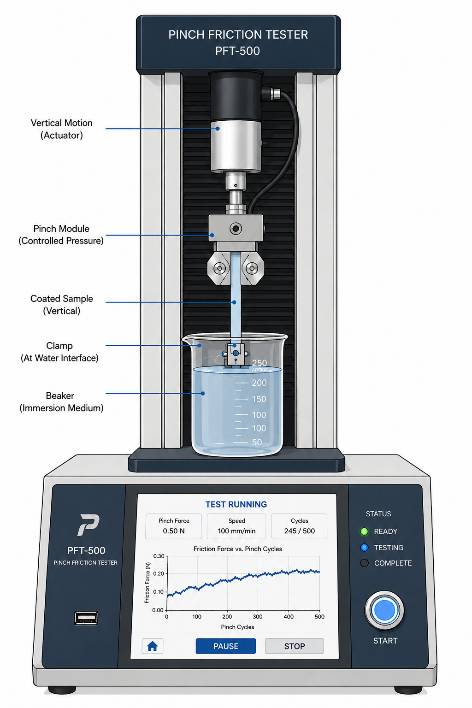
Our Pinch Friction Tester enables precise quantification of coating lubricity and mechanical durability under simulated clinical handling conditions. With our trained team of engineers running both coefficient of friction profiling and pinch testing on the same platform, we can generate comparative, reproducible data that device developers need for design decisions and regulatory packages.
Repeated use testing evaluates how a hydrophilic coating performs across multiple cycles of hydration, drying, and mechanical interaction. Coated samples are subjected to a defined number of insertion and withdrawal cycles through a fixture, with CoF measured under fully hydrated conditions before and after cycling. A coating that maintains a stable, low CoF across the full cycle series demonstrates the structural integrity and adhesion strength required for clinical use. Using our in-house pinch friction tester, Smart Reactors can generate the full repeated use friction profiles your coating development programme requires.
Particulate Matter Testing at Smart Reactors
For particulate matter analysis, conducted in accordance with USP <788>, we have the personnel and established protocols to quantify sub-visible particle generation from hydrophilic coatings. This provides clients with the safety and quality data required for submissions and while giving confidence that their coating won’t shed particulate matter during use.
Hemocompatibility and Biocompatibility Testing
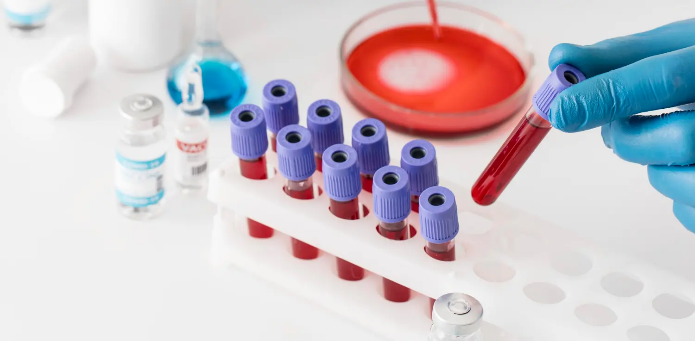
For device developers requiring biocompatibility, hemocompatibility, or cytotoxicity data, whether to satisfy ISO 10993 requirements or to support a broader regulatory submission, Smart Reactors offers a comprehensive testing service to ensure these studies are scoped correctly and delivered as part of a cohesive data package. Biocompatibility testing evaluates the overall biological response to a device or coating, assessing whether it is safe for its intended contact with the human body across a defined set of endpoints. Assessment of the response of blood to a device surface occurs during haemocompatibility testing. This examines parameters such as thrombogenicity, platelet activation, haemolysis, and complement system activation. These parameters are important considerations for any coating applied to a blood-contacting device. In the case of cytotoxicity testing, the coating or its leachable components are evaluated to determine if they elicit a toxic response in living cells and forms a foundational requirement for any device intended for patient contact. Together, these studies inform biological safety with all testing coordinated through a single point of contact, reducing project complexity.
Application-Specific Testing at Smart Reactors
While core characterisation methods such as friction, particulate, and biocompatibility testing form the foundation for hydrophilic coating qualification, the intended clinical application of a device introduces specific performance requirements. At Smart Reactors, we tailor our testing approach to reflect the specific conditions a coated device will encounter.
Urological Model Testing
To replicate the conditions that catheters and guidewires must endure, Smart Reactors employs validated urological model systems that simulate insertion through the urethra and into the bladder, allowing friction performance and coating integrity to be assessed under anatomically representative conditions.
Our urological models are designed to capture the mechanical stresses and surface interactions that occur during clinical use. Where required, testing can be conducted using artificial urine formulations to better represent the chemical environment of the urinary tract. This level of application specificity gives device developers confidence that coating performance data will translate from the laboratory to the clinical setting.
Shelf Life and Degradation Testing
Shelf life and degradation testing at Smart Reactors is designed to assess how a coating ages, both in its packaged, dry state and following hydration at the point of use.
Accelerated ageing studies are conducted in accordance with ASTM F1980, using elevated temperature conditions to simulate the passage of real time and generate shelf-life data within condensed project timelines. Following accelerated ageing, coated devices are re-evaluated across the full suite of relevant performance endpoints, including CoF, particulate generation, and where applicable, biocompatibility markers. Any meaningful change in these parameters following ageing provides early indication of coating instability and allows formulation or process adjustments to be made.
Coating delamination, matrix breakdown, and leachable generation are all potential degradation mechanisms that can compromise both device performance and patient safety. By combining friction profiling, particulate analysis, and extractables assessment at defined time points across the hydration period, Smart Reactors builds a degradation profile that characterises how a coating behaves throughout its functional life.
At Smart Reactors, our suite of characterisation capabilities, from friction and particulate analysis through to urological model testing, shelf-life assessment, and full biocompatibility evaluation, is built to support your coating development journey in its entirety. Whether you are searching for a new coating for your medical device or validating performance ahead of a product launch, our team brings the technical expertise and hands-on experience to deliver the data you need with confidence.
To find out more about our testing capabilities or to discuss the specific requirements of your coating programme, get in touch with the Smart Reactors team today.