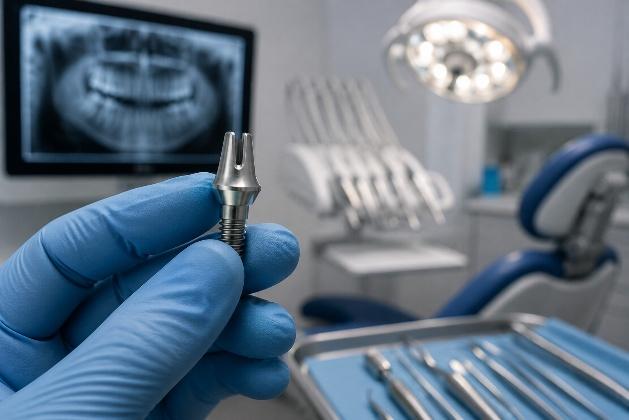
Dental Implants have been the standard method for the replacement of missing teeth. A key component of every implant system is the dental abutment, serving as the connection between the implant fixture which is embedded in the jawbone and the final prosthetic restoration, such as a crown or denture. It is positioned inside the implant protruding into the oral environment providing mechanical support and aiding recovering of the soft tissue around the implant.
Dental abutments are commonly manufactured from titanium or titanium alloys because of their high strength, corrosion resistance, and excellent biocompatibility. Beyond material selection, the surface characteristics of an abutment including its roughness, chemistry, and wettability have a significant influence on tissue integration and bacterial adhesion. As a result, improving the surface performance of dental abutments has become an important focus of implant research.
Problems associated with Dental Abutments
Despite the high success rate of dental implants, complications can arise around the abutment due to its constant exposure to the oral environment. Proteins rapidly absorb onto the surface of the abutment which in turn promotes bacterial attachment. Persistent bacterial colonisation can trigger inflammation of the surrounding soft tissues, leading to complications such as peri-implant mucositis and, if left untreated, progression to peri-implantitis. These conditions are the leading causes of implant failure and highlight the need for minimising bacterial adhesion to the abutment.

How Surface Coatings can help
Surface coatings provide an effective method to enhance the performance of dental abutments without affecting the underlying material of the implant. Coatings can be engineered to reduce bacterial adhesion, reduce oral inflammation, promote healing and optimise the interactions with surrounding tissues. Coatings achieve their effects through altering the surface chemistry, adding antimicrobial characteristics.
Beyond controlling bacterial colonisation, advanced coatings can also promote the attachment and proliferation of epithelial cells, supporting the formation of a stable soft tissue seal around the implant. By addressing several of the key biological challenges associated with dental abutments, surface engineering has emerged as a promising strategy for improving implant longevity, reducing complications, and enhancing long-term clinical outcomes.
How Camouflage™ can improve Dental Abutments Performance
Camouflage™ is an advanced surface coating designed around blood contacting medical devices. It is a biocompatible, non-drug surface coating that is engineered to enhance the performance of medical devices which it coats. There are several properties that the Camouflage™ coating possess that would be of great benefit when applied to dental abutments. The coating is designed to enhance endothelialisation through mincing native endothelial cells. This minimises negative biological interactions that could lead to infection and dental implant rejection.
Camouflage™ also possesses some antimicrobial characteristics. The passivating properties of the coating mean that bacterial cells cannot efficiently bind to the surface of material coated with Camouflage™. Due to the reduced levels of bacterial adhesion Camouflage™ coated devices do not succumb to the issues that most oral based devices faced which can eventually lead to biofilm formation.
Dental abutments are a key part of the lifecycle of a dental implant. They ensure the implant is allowed to heal, minimising the risk of implant rejection. However, abutments and implants can become covered in bacterial cells which can lead to inflammation, infection and eventual implant rejection. With a coating like Camouflage™, implant rejection would reduce and healing would become improved. The endothelialisation and antimicrobial properties of the coating allow improved patient health and increased rates of implant success.
Smart Reactors are leaders in advanced medical device coatings. We combine expertise in surface engineering, material science, and biological testing to create solutions tailored to specific clinical applications. From concept development through to performance validation, we work with partners to design coatings that enhance biocompatibility, minimise fouling, and improve long-term device performance.

To learn more about our coating development capabilities, explore our resources or contact our team to discuss your application.