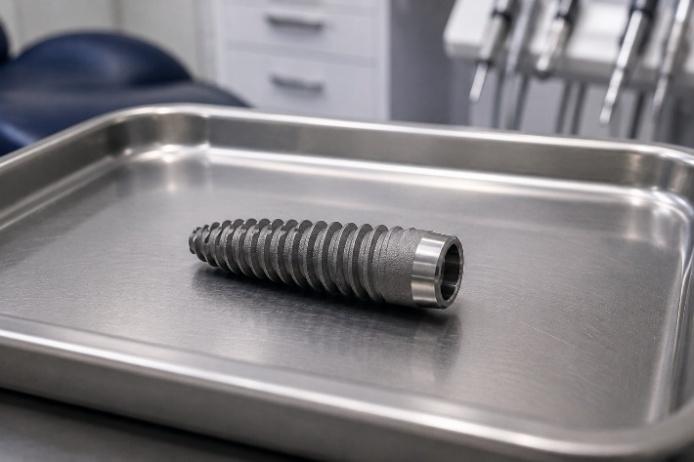
Dental implants are widely regarded as one of the most dependable and durable solutions for replacing missing teeth. Unlike traditional dentures or bridges, implants are surgically inserted into the jawbone, where they act as artificial tooth roots that support crowns, bridges, or full-arch restorations. Their ability to restore both oral function and natural appearance has made them a preferred treatment choice for many patients, with long-term success rates of over 90% in healthy individuals.
Most dental implants are made from commercially pure titanium or titanium-based alloys because of their outstanding strength, resistance to corrosion, and excellent biocompatibility. A key characteristic of titanium is its ability to develop a stable oxide layer on its surface, which allows it to bond directly with surrounding bone through a process called osseointegration. Achieving successful osseointegration is essential for implant stability and long-term success, making implant design and surface characteristics important factors in ensuring positive clinical outcomes.
Challenges Associated with Dental Implants
Although dental implants have shown high long-term success rates, both biological and mechanical complications may still arise. One of the main concerns is bacterial colonisation of the implant surface. After implant placement, proteins from saliva and blood quickly adsorb onto the surface, forming a conditioning film that promotes bacterial attachment. As these microorganisms accumulate and develop into mature biofilms, they can initiate inflammation in the surrounding tissues, resulting in peri-implant mucositis and, if progression occurs, peri-implantitis. Left untreated, peri-implantitis can cause progressive bone loss, compromise implant stability, and ultimately lead to implant failure.
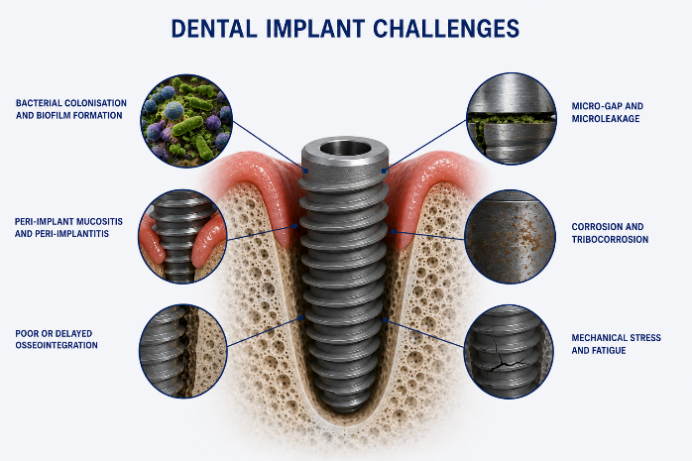
Another key challenge is achieving rapid and reliable osseointegration while preserving the long-term durability of the implant. During normal function, dental implants are subjected to repeated chewing forces, exposing them to cyclic mechanical stresses that may contribute to fatigue and surface wear over time. Furthermore, the oral environment is chemically demanding, with variations in pH, exposure to saliva and dietary acids, and frequent temperature fluctuations that can accelerate corrosion and tribocorrosion processes. Surface properties, including roughness, chemical composition, and wettability, strongly influence both bone cell responses and bacterial adhesion, emphasising the importance of carefully designed implant surfaces to optimise clinical performance.
How Coatings Can Limit These Challenges
Surface coatings have emerged as an effective strategy for enhancing the biological and mechanical performance of dental implants without altering the strength of the underlying material. By modifying only the implant surface, coatings can be designed to promote faster bone integration, improve corrosion resistance, and reduce bacterial attachment. Some coatings enhance surface chemistry or wettability to encourage osteoblast adhesion and bone formation, while others incorporate antimicrobial properties that inhibit bacterial colonisation during the critical early stages of healing.
Multifunctional coating technologies are also being developed to combine antimicrobial activity and enhanced biocompatibility within a single surface treatment. By addressing several of the key factors that influence implant longevity and clinical success, surface engineering offers significant potential to improve patient outcomes while reducing the risk of implant-related complications.
How Camouflage™ Can Help Dental Implants
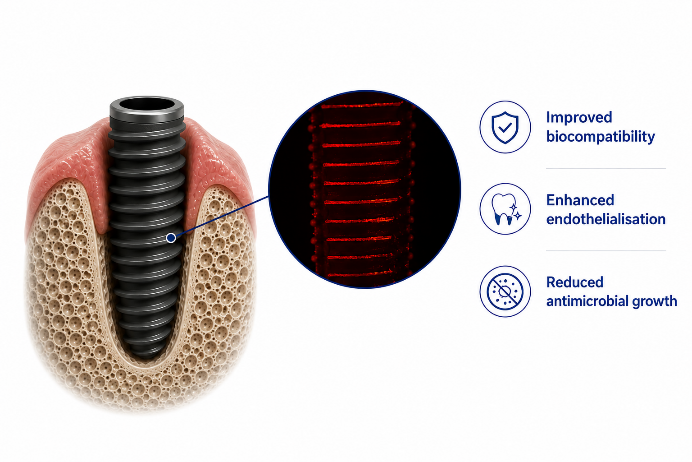
Camouflage™ technology is an advanced, biocompatible surface coating developed for blood-contacting medical devices. This non-drug technology is engineered to improve the performance of coated devices by enhancing their interaction with the biological environment while supporting safety and functionality. In invasive procedure such as dental implant insertion, preventing the antimicrobial growth is key. Bacterial colonisation can lead to infection and inflammation causing discomfort and effecting the overall healing process. Camouflage™ provides a lasting defense against microbial growth through its advanced surface chemistry.
Camouflage™ also promotes enhanced endothelialisation, supporting the cellular growth that is essential for successful healing following dental implant procedures. By encouraging tissue integration, the coating helps accelerate the healing process and contributes to improved implant outcomes.
Dental implants are a widely used and effective solution for replacing missing teeth, but their long-term success depends on proper healing and integration with surrounding tissues. Following implantation, bacterial colonisation of the implant surface can lead to inflammation, peri-implant infection, and ultimately implant failure.
A coating such as Camouflage™ could significantly improve the performance of dental implants by combining antimicrobial activity with enhanced endothelialisation. By reducing bacterial attachment while promoting tissue healing and integration, the coating has the potential to lower infection rates, improve patient outcomes, and increase the long-term success of dental implant procedures.
Smart Reactors are leaders in advanced medical device coatings. We combine expertise in surface engineering, material science, and biological testing to create solutions tailored to specific clinical applications. From concept development through to performance validation, we work with partners to design coatings that enhance biocompatibility, minimise fouling, and improve long-term device performance.
To learn more about our coating development capabilities, explore our resources or contact our team to discuss your application.