Hydrophilic coatings are polymer-based surface technologies applied to medical devices to reduce friction between the device and biological tissue. They are used extensively across a wide range of medical applications such as urology where lubricity directly influences patient safety and comfort.
Accurate characterisation requires testing methods that address various coating characteristics such as coating adherence, frictional properties, and surface integrity. The choice of method has a direct bearing on what conclusions can be drawn about a coating’s clinical suitability. This review describes the established testing approaches tailored to hydrophilic surface technologies, emphasising method selection based on relevant physicochemical properties and the intended pharmaceutical or biotechnological application.

Why Hydrophilic Coating Testing Is Essential
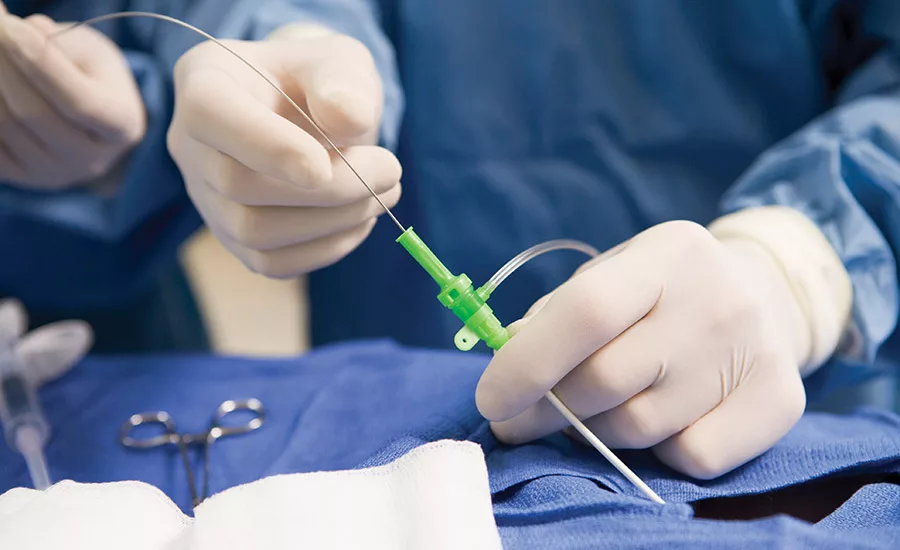
Medical devices that navigate through biological tissue, such as vascular or gastrointestinal tissue, exert frictional forces at the device-tissue interface during insertion and manipulation.
Lack of adequate lubrication can result in tissue trauma and vessel perforation. Hydrophilic coatings address this by absorbing water and forming a slippery hydrated polymer layer on the surface of the device, at the interface of the device and biological tissue, dramatically reducing friction when the device is wet.
However, a coating that performs well at the outset of a procedure but degrades under repeated handling, compression, or mechanical stress presents its own clinical risks. Delaminated coating material entering the bloodstream or surrounding tissue as particulate matter can provoke inflammatory responses or embolization. Hydrophilic Polymer Embolism (HPE) is a complication that arises from the shedding of particulate material, which can cause embolic events in the bloodstream and even lead to ischemic events. It is for this reason that hydrophilic coating testing extends beyond simple friction measurement to encompass particulate generation, durability under simulated use, and resistance to mechanical disruption. Testing is conducted in accordance with USP <788> and relevant ISO standards, with defined acceptance criteria.
Pinch Friction Testing
Pinch testing is carried out to assess coating integrity under localized compressive stress. The coated sample is compressed between two surfaces under controlled or consistent manual pressure, simulating handling that can disrupt weakly adhered coatings. This test is particularly relevant for devices that undergo manipulation or passage through haemostatic valves during clinical use.
As with repeated use testing, the primary indicator of performance is the change in CoF following pinch application. An increase in CoF after compression suggests damage to the hydrated layer or underlying coating structure. In contrast, a robust coating will maintain a low CoF and recover its lubricious surface immediately after release. Together, repeated use and pinch testing provide an understanding of coating durability that informs process development.

Repeated Use Testing
The durability of hydrophilic coatings can be tested through application of the repeated use testing method where coating integrity is tested under simulated real-world handling conditions. Coated samples are subjected to defined hydration and drying cycles, often combined with mechanical interaction via surface contact. The number of cycles and conditions are typically predefined to reflect expected use scenarios. Performance is primarily assessed through changes in the coefficient of friction (CoF), along with visual inspection of the coating surface. CoF is measured under hydrated conditions using a standardized method, with values compared before and after cycling. A stable coating will show minimal increase in CoF across cycles, indicating retention of lubricity. A low and consistent CoF is considered indicative of acceptable performance, though thresholds may vary by application. A CoF of <0.05 is commonly expected for well-performing hydrophilic technologies.
Particulate Testing
An important component of quality control for hydrophilic surface technologies is particulate matter testing, governed by the USP <788>. Due to the nature of the devices hydrophilic coatings are typically applied to, they are inherently more susceptible to particle generation through mechanisms such as delamination, precipitation, or aggregation. Consequently, ensuring product safety requires the control and quantification of particulate matter.
Two analytical approaches are specified in USP <788>, these are light obscuration particle counting and microscopic particle count testing. Of these two approaches, light obscuration particle testing is designated as the primary method and is the preferred method due to its sensitivity in detecting particles within defined size thresholds, ≥10 μm and ≥25 μm. Furthermore, light obscuration particle testing exhibits faster analysis and reduced operator dependency when compared to microscopic particle count testing. Acceptance criteria for particulate testing are defined by pharmacopeial limits, however lower particulate counts and less friction are desired.
In light obscuration particle testing particles interrupt a light beam while passing through the sensing zone. The resulting reduction in signal is then correlated to particle size. However, in cases where formulations exhibit high turbidity, contain air bubbles or display optical properties that may interfere with accurate particle detection, the microscopic method serves as an alternative approach. Microscopic analysis permits visualization and enumeration of particles, although this comes with increased operator dependency.
At Smart Reactors, we specialise in the development of advanced medical device coatings. Our multidisciplinary team supports the optimisation and validation of surface technologies for a wide range of medical applications. By combining advanced coating platforms with in-house characterisation and biological testing, we help partners address complex challenges relating to biocompatibility, durability, infection prevention, and device performance.
To learn more about our coating technologies and development capabilities, explore our resources or get in touch with the Smart Reactors team today.