Endovascular venous stent placement has become the standard of care for symptomatic venous obstruction, yet post-market surveillance data make clear that device failure remains a persistent clinical problem. A 2026 retrospective analysis of FDA MAUDE reports across 929 unique Medical Device Reports covering five venous-indicated stents (Venovo, Vici, Zilver Vena, Wallstent, and Abre) found that adverse event profiles differed significantly across platforms for both device-problem and patient-problem categories. Vascular complications, including thrombosis, restenosis, and occlusion, were the dominant patient-harm signal, most prominently in Zilver Vena (34.7%) and Abre (31.1%). Vici, which was subsequently recalled, was dominated by post-deployment migration or obstruction in 60.0% of reports. While device-specific mechanical factors contribute to these profiles, the data consistently implicate the blood-implant interface as a primary site of failure.
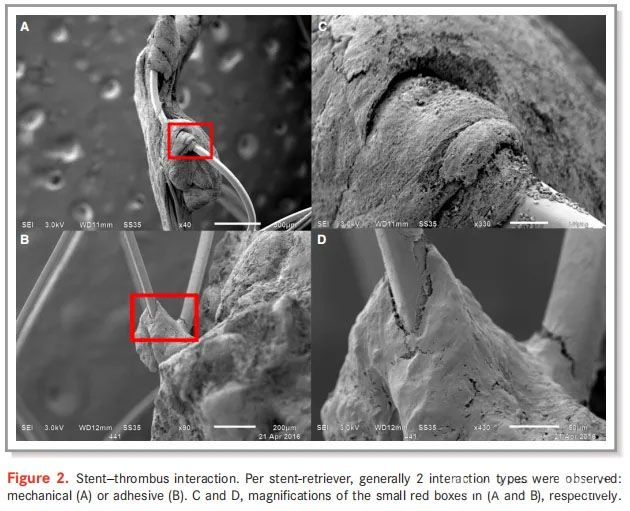
The biological mechanisms underlying these events are well established. When a metallic or polymeric implant is introduced into the venous circulation, the foreign surface initiates protein adsorption, platelet adhesion, coagulation cascade activation, and leukocyte recruitment. In low-shear venous environments these processes are compounded, lowering the threshold for thrombus propagation. Delayed endothelialisation further extends this thrombogenic window, increasing the risk of restenosis and late device failure. Across the five stents analysed in the MAUDE study, vascular complications accounted for the primary patient-harm indicator in two of the five platforms and represented a meaningful secondary indicator in a third.
Current venous stent platforms are differentiated primarily by structural properties. None have been approved on the basis of surface haemocompatibility, leaving coagulation activation, inflammatory signalling, and delayed endothelialisation largely unaddressed at the device surface. Camouflage™, a proprietary haemocompatible coating developed by Smart Reactors, is designed to target precisely these mechanisms.
Camouflage™
Camouflage™ is a proprietary haemocompatible, anti-thrombogenic coating developed by Smart Reactors. It combines a synthetic polymer with a protein base layer to create a passive, non-heparin, non-drug surface that reduces blood-material interactions while supporting vascular healing.
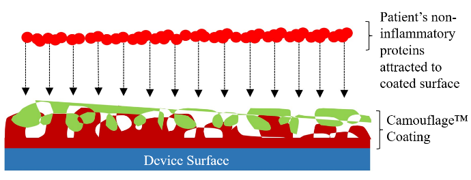
The mechanism is based on surface cloaking. Rather than pharmacological activity, Camouflage™ promotes adsorption of non-inflammatory proteins on the device surface, masking the implant from circulating blood components. This reduces activation of coagulation and inflammatory pathways while supporting endothelial cell attachment and proliferation.
Relevance Across Vascular Device Classes
The coating’s mechanism aligns closely with recurring adverse event patterns reported across vascular implants:
| Device Type | Common Failure Modes | Camouflage™ Benefit |
|---|---|---|
| Peripheral arterial stents | Thrombosis, restenosis, occlusion | Reduced thrombus initiation, improved endothelialisation |
| Carotid stents | Thromboembolic events, delayed healing | Enhanced haemocompatibility and endothelial coverage |
| Venous stents | Acute thrombosis, loss of patency | Reduced coagulation activation in low-flow environments |
| Flow diverters | Thrombus deposition, delayed neointimal formation | Improved endothelial cell attachment and healing |
| EVAR/TEVAR grafts | Limb thrombosis, graft occlusion | Improved blood-surface compatibility and reduced clot formation |
Reducing Thromboembolic Risk
Thrombus formation is one of the most frequently reported complications in vascular implants. MAUDE data confirms this pattern across venous stent platforms with thrombosis, restenosis, and occlusion accounting for vascular complications in up to 34.7% of reports for individual devices. Smart Reactors’ haemocompatibility studies illustrate that, following exposure to blood, Camouflage™ coated surfaces show minimal fibrin formation and reduced platelet activation compared with uncoated controls. In contrast, uncoated surfaces showed significant erythrocyte accumulation and visible fibrin network formation, indicating clot formation progression.
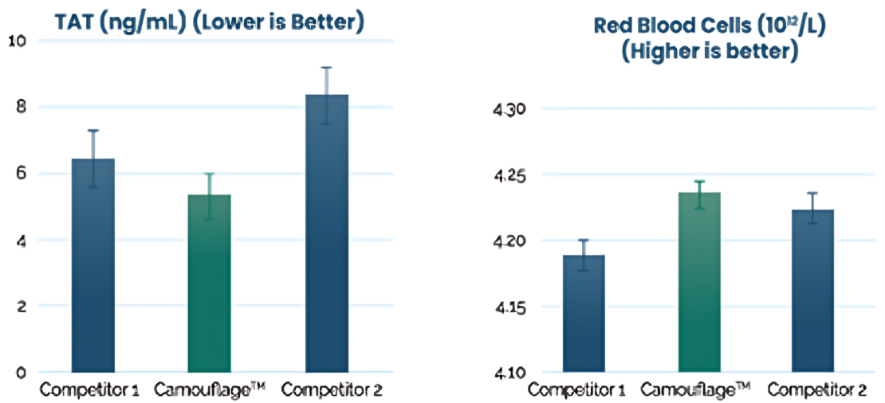
Additional perfusion studies demonstrated reduced thrombin-antithrombin complex (TAT) generation, reduced leukocyte adhesion, and lower inflammatory marker expression compared with benchmark coating technologies. These findings suggest a reduced tendency to activate coagulation and inflammatory pathways.
For devices such as venous stents, flow diverters, carotid stents, and aortic endografts, reducing coagulation activation at the device surface may help mitigate complications such as acute occlusion and thromboembolic events.
Accelerating Endothelialisation
The success of long-term implants is dependent on rapid endothelialisation. A functional endothelial layer converts the implant surface into one that behaves like native vessel wall, which is the primary mechanism for sustaining long-term patency.
Camouflage™ has demonstrated enhanced endothelial cell attachment and viability on nitinol substrates. In a rabbit carotid implantation model, coated stents exhibited more rapid endothelialisation than uncoated controls, with no observed thrombus formation during early evaluation periods. By 24 hours and 14 days post-implantation, coated devices showed accelerated endothelial coverage compared with controls.
This characteristic is particularly relevant for:
- Neurovascular flow diverters requiring rapid neointimal coverage.
- Carotid stents where delayed healing may prolong embolic risk.
- Peripheral and venous stents where long-term patency depends on stable endothelial integration.
Controlling Inflammation
Inflammation contributes to restenosis, neointimal hyperplasia, and chronic implant failure. Camouflage™ promotes the adsorption of non-inflammatory proteins to the biological interface while reducing immune recognition of the implanted material. Reduced leukocyte adhesion and inflammatory marker expression have been observed during in vitro testing.
By minimizing inflammatory activation at the implant surface, Camouflage™ supports more controlled vascular healing and reduce the biological drivers of late lumen loss.
Conclusion
MAUDE surveillance data identify thrombosis, occlusion, and vascular injury as persistent challenges across stents, flow diverters, and endovascular grafts. Camouflage™ targets these mechanisms directly through a passive surface that reduces coagulation activation, promotes endothelialisation, and limits inflammatory response. These characteristics position it as a platform technology for improving long-term performance across venous, cardiovascular, and neurovascular implants.
Smart Reactors are leaders in advanced medical device coatings. We combine expertise in surface engineering, material science, and biological testing to create solutions tailored to specific clinical applications. From concept development through to performance validation, we work with partners to design coatings that improve long-term device performance.
To learn more about our coating development capabilities, explore our resources or contact our team to discuss your application.